Accelerated vs. Traditional Instrument Rating Training in 2026

Published by:
Todd O.
Published on:
Read time:
8 min read
Two private pilots both want the same thing: an instrument rating so they can fly into the clouds with a clear head. One has two open weeks this month and books a block of back-to-back training days. The other has Saturday mornings and starts a lesson every week. Both can finish, and they end up on very different calendars.
If you are comparing accelerated instrument training with the traditional route, this post lines the two up on five things you can measure: structure, time on the calendar, how hours are earned, cost drivers and outcomes. At Solid Ground Aviation, we will not tell you one wins. We will show you where they differ and who each one suits. The details behind each row live in our guides to the timeline, the requirements, the cost mechanics and choosing a pace.
What each path means before you compare them
Both paths lead to the same rating, added to your private pilot certificate, and both answer to the same FAA rules and the same checkride standard. The difference is the shape of the training.
Accelerated training packs your lessons into tight blocks of consecutive days, with a simulator doing much of the early procedure work. Our Accelerated Training for Traveling Pilots program is built around 2 to 3 consecutive days of simulator training, and the airplane flights and checkride come after that block.
Traditional training means open-ended weekly lessons, usually one or two a week, flown in an airplane. You keep your normal routine, and the rating arrives whenever the lessons add up.
The side-by-side table
Here is the comparison in one place. Each row is a question you can ask any school, including us.
| What you can measure | Accelerated (block, simulator-assisted) | Traditional (weekly airplane lessons) |
|---|---|---|
| Structure | Tight blocks of consecutive days, with a simulator phase first and airplane flights after it | One or two lessons a week, mostly in the airplane, with no fixed end date |
| Time on the calendar | Less spread out, because lessons sit close together | More spread out, because each lesson waits for the next open slot |
| How hours are earned | Part of the instrument time comes from an approved training device, the rest from the airplane | Instrument time comes mostly from the airplane |
| Cost drivers | Training-device hours, airplane hours, fewer repeat hours when gaps are short | Airplane hours, instructor time, repeat hours when gaps are long, spending spread over more months |
| Weather exposure | Simulator sessions run in any weather; airplane flights still follow it | Every lesson follows the weather |
| Outcome | Same FAA requirements and same checkride standard | Same FAA requirements and same checkride standard |
Our Instrument Rating Accelerator is the program built around the accelerated column. The sections below take each row in turn.
Structure: where the first ten minutes of a lesson go
Think about the start of a weekly lesson. You sit down with your instructor and spend the first ten minutes remembering how the last lesson ended. A holding pattern entry, an approach briefing and a missed approach call-out are small procedures, and they fade between sessions. Gaps usually mean part of the next lesson goes to review.
A weekly rhythm has its own structure benefit. You get days between lessons to read an approach plate, rehearse a briefing and let new ideas settle. Some pilots learn best that way. If you tend to forget a procedure in a week, tight spacing probably helps you. If you need time to absorb, spacing may suit you better. For a closer look at that choice, read our guide to choosing a pace.
Time on the calendar: what no pace can shorten
An accelerated block compresses the calendar, but it cannot erase the airplane items. You still need 3 hours of instrument training in an airplane within the 2 calendar months before your checkride, and one IFR cross-country flight of 250 nautical miles with approaches. No simulator replaces either one. Our timeline guide walks through how those pieces line up.
A traditional schedule has to respect the same 2-month window, which is where slow plans get caught. If lessons slip for a few weeks, earlier airplane training can fall outside the window and you may repeat it. Count backward from your target checkride date, whichever path you choose.
Weather touches both paths, but differently. Weather stops airplanes, not simulators, so simulator sessions keep running when a front sits over Maryland. Our weather-proof training guide explains how that works for our students.
How hours are earned: the FAA’s rule for training devices
The FAA requires 40 hours of actual or simulated instrument time, including 15 hours of instrument training from an authorized instructor, plus 50 hours of cross-country time as pilot in command, 10 of them in an airplane.
On the traditional path, most of that instrument time comes from the airplane. On an accelerated path, some of it can come from an approved training device. The FAA caps that credit at 10 hours in a basic device and 20 hours in an advanced device. The credit applies only when the device is FAA-approved, an authorized instructor provides the time, and the FAA has approved the instrument tasks flown in it. Those caps are the ceiling for any plan, and the amount a given plan uses depends on the device and the tasks flown.
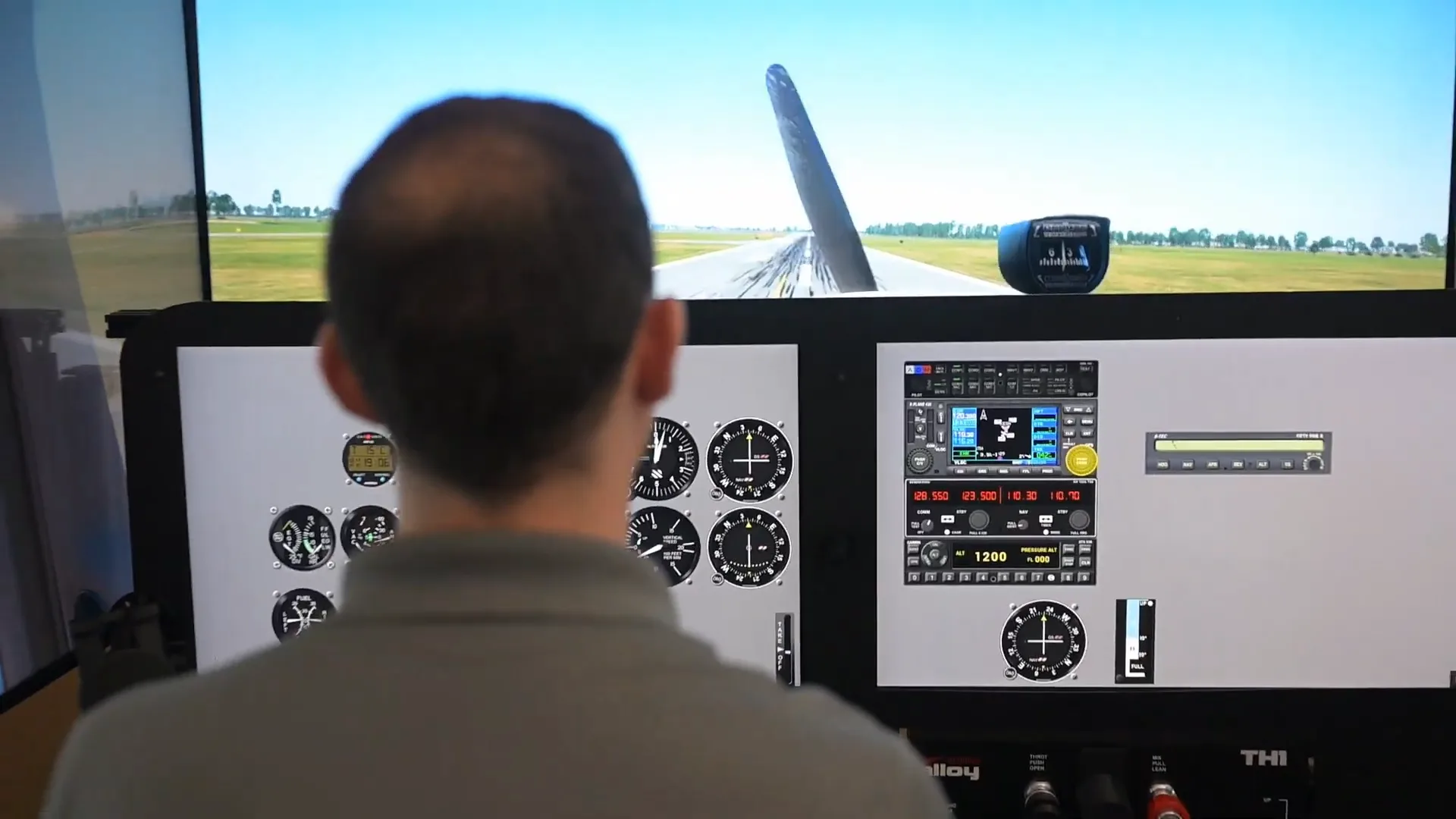
Our SG-2 simulators are FAA-approved AATDs, and you can see them on our simulators page. Because the caps sit below 40 hours, you cannot earn the whole rating in a simulator. The airplane stays in your plan on either path.
Cost drivers: what changes the bill and what does not
Every instrument rating bill has the same parts: airplane rental, instructor time, training-device fees, ground study, the FAA knowledge test, and the examiner’s fee for the checkride. The two paths move the weight of each part, and neither one removes the bill.
Simulator hours cost less per hour than airplane hours, so every hour that moves from the airplane to an approved device changes your bill by the gap between the two rates. Repeat hours push the other way. Long gaps, weather cancellations and relearning all add lessons you pay for twice. A traditional path spreads the spending across more months, which some budgets prefer. An accelerated path asks for more of it in a shorter window.
We are not going to put a total on either path here. Your cost depends on how quickly you reach checkride standard, on rates, and on how many hours move to a device. Our cost guide shows the arithmetic, and when you meet with us, bring your budget or financing plan so the schedule and the budget fit each other.

Who each path suits
Start with your calendar and your learning style.
Accelerated tends to fit you if:
- You can clear several days in a row, or you travel in for a block.
- You forget procedures between lessons and want tight spacing.
- You want simulator sessions that do not depend on the weather.
- Your calendar is open now and crowded later.
Traditional tends to fit you if:
- You have steady weekly slots but no long open stretch.
- You learn best with days between lessons to absorb new material.
- You prefer to spread your spending over more months.
- You want the airplane in your hands from lesson one.
Some pilots land in between. If your calendar has an open stretch now and a busy season later, a mixed plan may fit. Contact us and we will map the plan with you, starting from your calendar. For a first look at how our simulators work, read about the SG-2 simulator system.
Accelerated vs. traditional instrument training FAQ
Is accelerated instrument training easier?
No. Both paths meet the same FAA requirements and the same checkride standard. An accelerated block asks for more of your attention in a short window, and a weekly plan asks for steady discipline over a longer one.
Can I earn an instrument rating entirely in a simulator?
No. The FAA caps device credit at 10 hours in a basic device and 20 in an advanced device, and you still need airplane instrument training and a 250 nautical mile IFR flight. Our requirements checklist covers the full list.
Is accelerated training cheaper than traditional training?
It depends on your plan. Simulator hours cost less per hour than airplane hours, and short gaps can reduce repeat hours. Your total still depends on rates and on how quickly you reach the standard.
Which path gives me a better chance at the checkride?
Neither path changes the standard. Readiness decides, and your instructor recommends you when you meet it.
What if I start weekly and want to speed up later?
Your plan can change with your calendar. Tell us what your schedule looks like now and in a few months, and we will help you find where a block of days fits.
Ready to pick the shape that fits your calendar?
Tell us your open days, how you like to learn and when your busy season starts. We will lay out both paths against your calendar and your budget or financing plan, and we will show you where the simulator sessions go and where the airplane flights fall. Contact us to map your instrument rating plan.