
How to Log FAA Flight Hours for Half the Price: The Smart Pilot's Guide to AATD Sim 2026 Training

Published by:
Todd O.
Published on:
Read time:
8 min read
When you sit down to calculate the cost of earning your next certificate or rating, the price of modern aircraft rental can stop your momentum cold. Renting a traditional training aircraft like a Cessna 172 or Piper Archer in 2026 regularly costs between $190 and $260 per hour wet, and hiring a seasoned flight instructor pushes your total hourly expense well past $270.
At those rates, a student working toward an Instrument Rating or logging flight experience for a Commercial Pilot Certificate can easily spend tens of thousands of dollars on aircraft engine tach time alone. Many aviators assume their only option is to keep swiping a credit card on expensive fuel and airplane maintenance.
What many pilots fail to realize is that the Federal Aviation Administration provides a completely legal, structured path to log dozens of required flight training hours in an approved flight simulator. If you are searching for the cheapest FAA-approved flight simulator options to earn your wings without draining your savings, here is the exact regulatory breakdown of what you can log, how the math works, and how to maximize your logbook.
Understanding FAA Simulator Classifications: BATD vs. AATD
To ensure your simulator hours count legally toward an FAA certificate or practical test, the training device must hold an official FAA Letter of Authorization (LOA). Desktop flight simulation setups at home are helpful for basic familiarity, but you cannot log legal flight experience on an uncertified home system.
The FAA categorizes ground training devices into two primary civilian tiers:
1. Basic Aviation Training Devices (BATD)
A BATD provides approved training hardware with basic aerodynamics and control inputs. While valuable, federal regulations restrict how many total hours you can log on a BATD. For example, under Part 61, you can only log up to 10 hours toward an Instrument Rating on a basic device.
2. Advanced Aviation Training Devices (AATD)
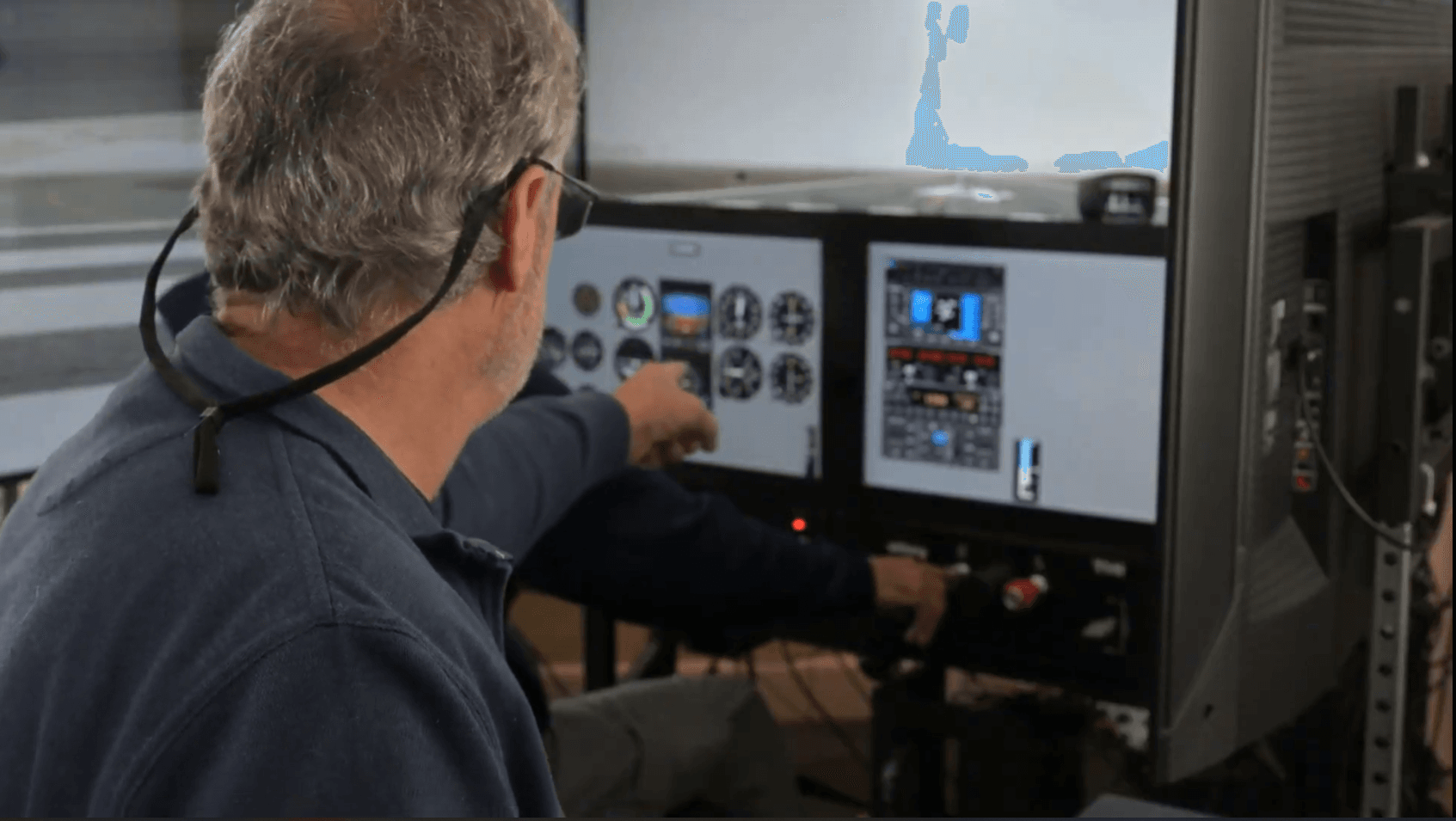
An AATD represents the highest level of personal flight training simulation approved by the FAA before reaching multi-million-dollar Level D airline simulators. An AATD requires:
- Realistic physical flight controls featuring dynamic force feedback.
- Accurate cockpit panels matching specific aircraft configurations, including traditional six-pack steam gauges and modern Garmin G1000 suites.
- Expansive visual systems that wrap around your peripheral vision for realistic VFR and IFR maneuvers.
- An independent instructor operating station capable of failing individual instruments, alternators, and weather conditions on demand.
Because of this superior fidelity, the FAA permits you to log twice as many hours on an AATD as you can on an entry-level BATD.
At Solid Ground Aviation, we operate the SG-2 FAA-approved AATD at Tipton Airport (KFME) in Fort Meade, Maryland. You can explore our hardware specifications on our dedicated SG-2 flight simulator page.
The Official FAA Logbook Limits Under Part 61
Under Title 14 of the Code of Federal Regulations (14 CFR Part 61), here are the maximum hours you can officially credit toward your certificates and ratings using an FAA-approved AATD:
| Certificate or Rating | Applicable Regulation | Maximum Loggable AATD Hours | Total Minimum Requirement |
|---|---|---|---|
| Private Pilot Certificate | 14 CFR § 61.109(k) | Up to 2.5 hours | 40 hours minimum |
| Instrument Rating | 14 CFR § 61.65(i) | Up to 20 hours | 40 hours actual or simulated instrument |
| Commercial Pilot Certificate | 14 CFR § 61.129(i) | Up to 50 hours | 250 hours total aeronautical experience |
| Airline Transport Pilot (ATP) | 14 CFR § 61.159(a)(6) | Up to 25 hours | 1,500 hours total aeronautical experience |
| Instrument Currency (6-HITS) | 14 CFR § 61.57(c)(2) | 100% of tasks | 6 approaches, holding, intercepting |
| Instrument Proficiency Check (IPC) | 14 CFR § 61.57(d) | Approved ACS tasks | Endorsement upon completion |
Note: If you are enrolled in an approved Part 141 flight school curriculum, your allowable simulator credit can reach up to 35 hours for an Instrument Rating.
The Real Math: How Much Money Do You Actually Save?
To see the real-world impact on your wallet, let’s examine the numbers for a student working toward an Instrument Rating under FAR Part 61.
An Instrument Rating requires a minimum of 40 hours of instrument flight time. Compare the two paths available to you:
Path 1: Traditional 100% Aircraft Training
- 40 hours in an aircraft at $220/hr wet = $8,800
- 40 hours of CFI dual instruction at $75/hr = $3,000
- Total Aircraft Instrument Cost = $11,800
Path 2: The AATD Simulator-Hybrid Model
- 20 hours in the aircraft at $220/hr wet = $4,400
- 20 hours in our FAA-approved AATD at $65/hr = $1,300
- 40 hours of CFI dual instruction at $60/hr = $2,400
- Total Hybrid Instrument Cost = $8,100
By shifting half of your instrument hours to an approved AATD, you save $3,700 on direct rental costs alone.
Furthermore, in an actual aircraft, you lose 15 to 20 minutes of every flight lesson taxiing to the runway and flying out to an approach fix. In our simulator, every single minute is dedicated to instrument approaches, holding patterns, and partial-panel emergency workflows.
You can examine our side-by-side simulator vs. traditional training cost comparison to see how these savings scale across career pilot paths.
Logging Solo IFR Currency Without an Instructor
For licensed instrument pilots, maintaining legal currency under 14 CFR 61.57(c) often feels like a constant financial drag. Finding a safety pilot on weekends, booking an aircraft, and burning hundreds of dollars in fuel just to fly under foggles is burdensome and expensive.
Under federal regulation 14 CFR 61.57(c)(2), if you are within your six-month currency window, you can log all six approaches, holding procedures, and nav-tracking tasks solo in our FAA-approved AATD.
Explore our Instrument Currency program to see how local pilots maintain sharp instrument reflexes throughout the year.
Essential Rules for Logging Simulator Time Accurately
When presenting your logbook to a Designated Pilot Examiner (DPE) or FAA inspector, accurate logbook documentation is critical:
- Never Log Sim Time as Flight Time: Record your simulator sessions under the “Synthetic Trainer,” “Flight Simulator,” or “Aviation Training Device” columns. Never enter simulator time in the total flight duration column.
- Document Instrument Time Correctly: When completing dual instrument sessions in an AATD, log the time under “Instrument Training Received.”
- Record Device Authorization Details: Each logbook entry should specify the device type (AATD), manufacturer and model (Solid Ground Aviation SG-2), and reference the active FAA Letter of Authorization.
- Obtain Proper Instructor Signatures: For hours applied toward certificates or ratings, an authorized CFI or CFII must sign the entry with their certificate number and expiration date.
Take Command of Your Flight Training Budget
Whether you are progressing through our Instrument Rating Accelerator, building time for your Commercial license, or refreshing your instrument scan, training in an FAA-approved AATD is the smartest tactical move you can make.
At Solid Ground Aviation, we combine airline-level instructional expertise with state-of-the-art simulation technology to deliver high-density flight training that respects your budget.
Ready to log legal FAA flight hours for half the price? Book your simulator session at Solid Ground Aviation today and see firsthand how our AATD training gets you checkride-ready faster.